These pages explain why the system is shaped the way it is. Each chapter takes one mechanism and says what it is, how it works, which failure it prevents, and where in the source that lives. Someone who wants to install the store, write a memory, or operate a curation run is served by Learn. Someone who wants the exact spelling of a flag or an error code is served by Reference.
1. Two invariants
Section titled “1. Two invariants”Two rules hold the design together. Most decisions in the chapters below follow from one of them, and most of the bugs this system has had came from breaking one of them.
The first rule is that the git repository holds the facts, and .memhtml/index.db is a derived copy that can be thrown away. A derived copy like that is called a projection, meaning every row in it is computed from files in the tree and nothing is stored there first. git ls-tree regenerates the whole database (packages/store/src/layout.ts:25, packages/store/src/layout.ts:55), which is why the index is gitignored. Anything that has to survive rm index.db lives in a file instead: authored links are <link> elements and metadata is <meta> elements. Embeddings and mined edges can be recomputed, so they live only in the index. The state plane breaks the pattern, because it holds access counts and reinforcement history that no file in the tree records, so it carries a committed sidecar file as its durable copy.
Figure 1 draws that rule. Three ways of writing reach one tree, and two databases are derived from it.
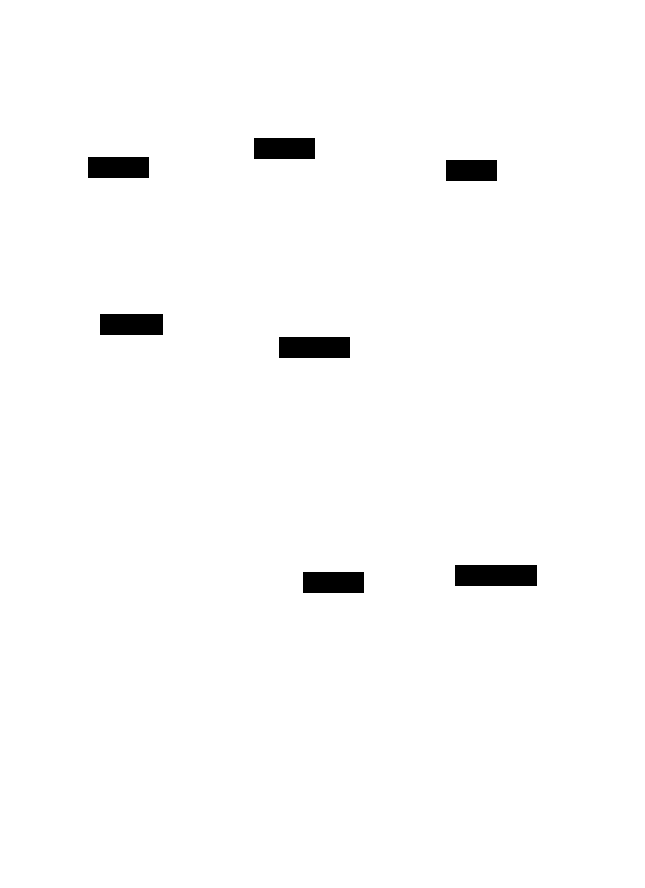
Figure 1: every write door lands in the git tree, and every read is served from a database derived from it. The three doors differ in who owns the commit and never in where the fact lands. index.db is drawn with a dashed border because deleting it loses nothing. state.db is drawn as a database on disk because a rebuild cannot reproduce it.
The second rule is that each change to the corpus is exactly one git commit. git log is then the history of what the agent learned, and diff base..HEAD is a curation run a human can review (packages/store/src/store.ts:37-44). The store stages files itself, because a caller that staged its own could put two unrelated writes into one commit. Eviction is a git mv into archive/<YYYY>/ that mirrors the original path underneath, so git log --follow reads through a memory’s whole life. No path in the system removes a file from the repository.
Figure 2 follows one memory through that rule. One commit brings it in, and each of the three ways out is also a commit.
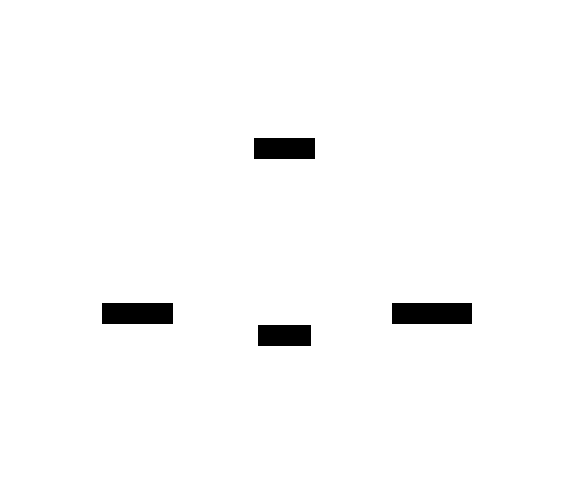
Figure 2: a memory has one entry and three exits, and each exit keeps the file. memhtml correct writes the replacement and archives the original in one commit. Retention triage archives a file whose score fell into the evict band. Compression archives a member underneath a newly written canonical memory. All three land under archive/<YYYY>/ with the original path mirrored beneath, which is what lets git log --follow read straight through.
2. The chapters
Section titled “2. The chapters”The chapters run in dependency order: the layers first, then the paths through them, then the pipelines and the contract surface.
| Chapter | What it settles |
|---|---|
| Packages and dependency direction | The layering, the enforced purity of the pure packages, and the one composition root |
| Store layout and path algebra | The four top-level buckets, placement as a pure total function, the invertible archive mapping |
| The memory file format | The closed vocabulary, the two hashes, byte-splice head edits, the render gate |
| Edge encoding | Authored versus derived edges, the four non-mixing classes, the derived firewall |
| The write path | Ordering as the dedup mechanism, batch atomicity, the propose-only conflict assist |
| The index | Two databases on one connection, the schema, projection, rebuild and incremental update |
| Four-arm retrieval | The arm registry, rank fusion, degraded mode, diversification, the disclosure fold |
| The index plane and the state plane | What git cannot reproduce, and the byte-stable committed sidecar that saves it |
| The trace indexer | A read-only index over session transcripts, and the table-name firewall around it |
| The sleep pipeline | Seventeen phases, per-phase isolation, commit trailers as the resume mechanism |
| Concurrency and conflicts | Git as the concurrency mechanism, and typed conflict surfacing |
| The envelope contract | One JSON envelope, append-only codes, the tool surface and its forced choices |
| The extension contract | The five open axes a consumer models its domain on, and the four closed vocabularies |
| Testing posture | Real driver, real git, two fakes, and the quality gate that can refuse a merge |
Three pages sit beside the chapters. The consolidator reproduces the live system prompt of the agent that distills memories out of transcripts. Measured standing carries the benchmark numbers together with the caveat that governs how to read them. The glossary defines the domain vocabulary these pages use and links each term to the chapter that develops it.
3. How to read a citation
Section titled “3. How to read a citation”Every architectural claim on these pages names the code that implements it, in repo-relative path:line form, as in packages/index/src/retrieval-sql.ts:271-273. A line number points into the commit the site was built from, so treat it as a pointer rather than a permanent address. Where a claim rests on a measurement rather than on code, the measurement carries its date, because a probed number is a fact about one specific build of one specific dependency.